Friday, September 25, 2015

How about a quickie at four?


True to their name, these Four o'clock moths (Dysphania numana)) are usually active late in the afternoon, and it is uncanny how many times we have observed them around 4pm. In this case these couple turned up mating at our home at about 4.30pm.

The host plant for these moths is Corky Bark (Carallia brachiata), and the caterpillars are just as spectacular as the moths. See one in this previous post.

Sunday, May 31, 2015

Fantastic Phyllium

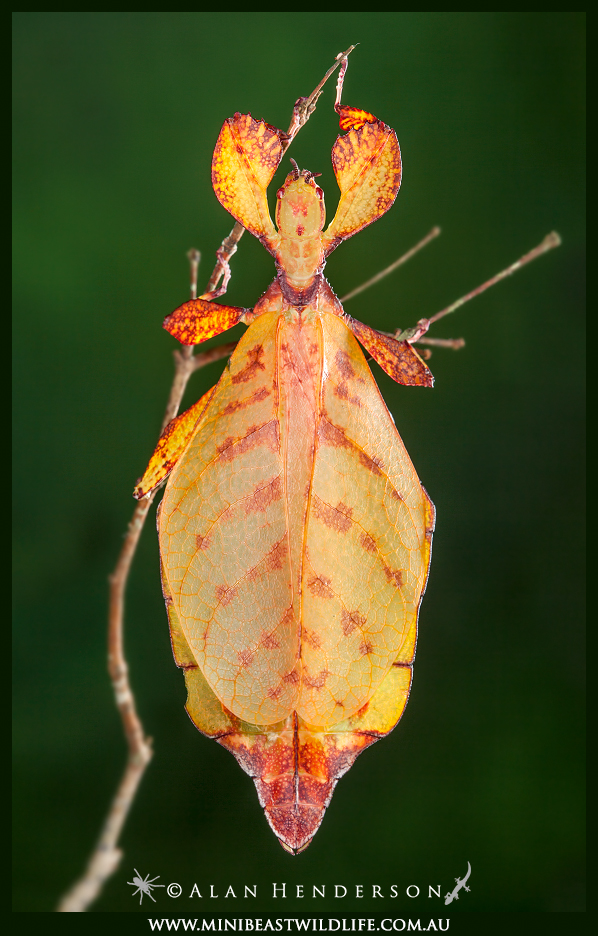
Here are some of the Phyllium monteithi Leaf Insects we have been breeding. One of our populations originated from a single female specimen that Gerhard Hillmann and myself happened across after Cylone Ita last year here in Kuranda. Gerhard spotted the adult female sitting upon Golden Penda (Xanthostemon chrysanthus). A rare find as she was only the second female specimen ever found at that point. The first was also found in Kuranda in 2012 on Cape Ironwood (Gossia floribunda). The offspring from the Cyclone Ita female have been kept on Golden Penda and are exhibiting an array of colours. The other main food plant we use is Brush Cherry (Syzygium australe), which is also likely to be a wild food host plant for this species.

The wild female in the position she was found on Golden Penda.

A red-morph adult female

The red colouration makes the insect obvious in this image, but would provide good camourflage on some of the rusty red coloured Penda leaves.


A female offspring from the wild female above with more red flecks.

An large female nymph with some 1st instar nymphs on her back.

An adult female on Golden Penda.

An all green female raised on Syzygium australe.

A brilliant green juvenile female.

Saturday, January 17, 2015

Amazing antennae

This is Callirhipis cardwellensis (Callirhipidae), a beetle with spectacular antennae. This little guy is one of many species on the move here in north QLD with the onset of the wet season here in Kuranda


Friday, October 11, 2013

Carnivorous snail

While 'carnivorous' and 'snail' are two words that most people wouldn't expect to find next to one another, these slow moving predators are actually quite common in some regions of the wet-tropics.  
 
This is one of our local carnivorous snails, Strangesta sp. (Rhytididae). Here is a series of photos showing it attacking and consuming a young Hadra webbi. Strangesta spp. have an extendible mouth part known as the buccal mass. It is a long, cylindrical muscular organ - the white tissue visible in the last image. This is extended inside the shell of the prey to enable the radular to access the soft tissue.


Monday, August 19, 2013

Colour variation in captive Onchestus rentzi

For a while now we have been captive breeding a genetic population of 'lichen-form' Crowned Stick Insects (Onchestus rentzi). Although these insects are somewhat variable in colour, the most common colour form is brown. Over recent years we have noticed some individuals within our main breeding colony exhibiting a lichen-like trait. Last year we decided to experiment with a few of those to see if the trait was genetic or the result of environmental influences including lighting and food plant.

We separated three young lichen-form females and let them mature in isolation, but kept them under the same conditions as our main group. The three females matured and began to lay eggs without being mated. The species is believed to be parthenogenetic but we had never tested it, so we were quite interested to see if the eggs they laid were even fertile. Those eggs are now hatching and the resultant offspring are indeed the same colouration as the females that produced them.

Two or the original three females are still alive and laying eggs on a daily basis. Recently though, the eggs that they are producing are different in appearance than previously. Normally the eggs are uniform brown, ranging from tan through to a chocolate colour - exactly what these individuals have been producing until now. These recent eggs are two-tone like the insects themselves, with a splash of white across the posterior end. We are not sure why this is occurring but will continue to observe and document these insects with interest.

One of the original 'lichen-form' females.

The eggs laid recently exhibiting an unusual colour trait.

Sunday, June 2, 2013

Paralysed and waiting


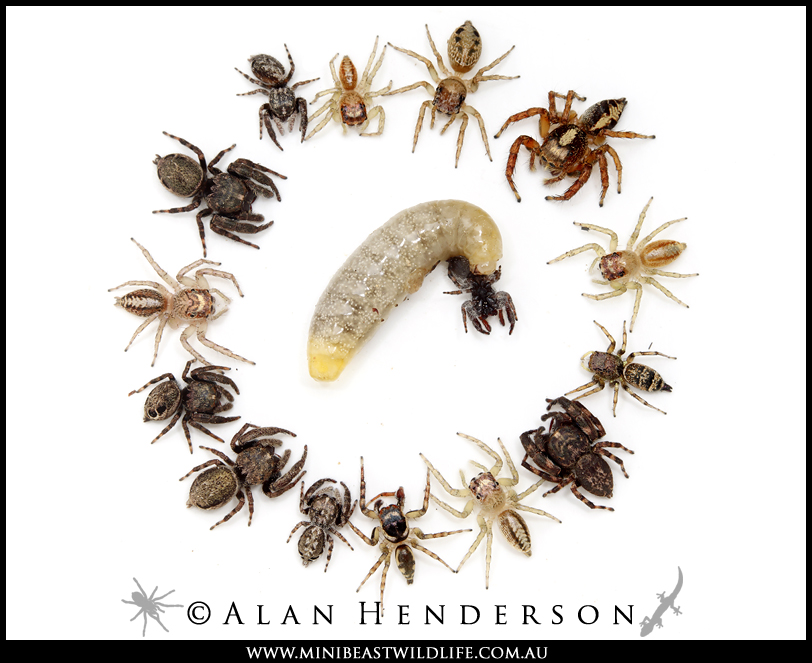
We accidentally broke open a mud-dauber wasp nest under our house while moving some equipment. The mud cells were packed with paralysed jumping spiders of multiple species. The culprit was a slender orange wasp belonging to the genus Sceliphron obviously specialising in spiders from the family Salticidae. 

The adult female wasp captures and paralyses the spiders and then packs them into the mud cells. She then lays an egg before closing the cell over with mud. The spiders are paralysed, but not killed so that they do not rot and the wasp larva can consume them over time. I rearranged the contents of one cell for this photograph. A wasp larva is in the centre in the process of consuming a spider.


Saturday, June 1, 2013

Break the drought!

It has been quite a while between posts, time flies!  We've been busy running our Minibeast Wildlife operation and working on a book...or two! We are currently working on the first of a series on the husbandry of Australian phasmids.

To get things rolling again here are some images taken over the past few months around around our region.

Jungle huntsman, Heteropoda jugulans

Cotton Harlequin Bug, Tectocoris diophthalmus. This species can be found feeding on a variety of Hibiscus spp.

A very cryptic crab spider, Stephanopis sp.

A hatchling Kirby's Stick Insect, Xeroderus kirbii. This specimen was found on Melaleuca just west of Kuranda.


Argyrodes sp. These bizarre spiders are kleptoparasites found in and around the webs of the large orb-weavers Nephila pilipes.

An assassin bug Gminatus sp. feeding upon a caterpillar.

Monday, February 18, 2013

Big eyes at Cape Tribulation

A couple of snaps from Cape Tribulation this week, featuring a couple of invertebrates with very impressive eyes.

A small Monkey Grasshopper (Biroella sp.). The large red compound eyes combined with the black pseudopupils give these grasshoppers a charasmatic appearance.

A Net-casting Spider (Deinopis subrufa) in the latter stages of producing an egg sac. The spider was continually turning the egg sac with her legs whilst adding silk in a dabbing motion with her spinnerets. Nest-casting Spiders are visual hunters. Two of their eyes are huge allowing them to accurately strike their prey with their net.

Tuesday, February 12, 2013

Another impressive catch

We found this amazing scene in the foliage beside our driveway. A small Ornate crab spider (Poecilothomisus speciosus) had captured an adult male Jungle huntsman (Heteropoda jugulans). Crab spiders are renowned for capturing prey larger than themselves, but taking down a predator of this size is very impressive. Even more remarkable was that the crab spider was operating on 5 legs - it had lost three some time prior on its right side.

Thursday, January 3, 2013

Punching above their weight

Crab spiders (Thomisidae) are ambush hunters, spending most of their time waiting motionless for invertebrate prey to come within reach. When they do strike, they simply grasp their prey with their front two pairs of legs and pull it toward their fangs. Their venom appears to be very fast acting as they have the ability to subdue animals many times their own weight and do so quickly with a minimum of fuss. While filming crab spiders in Costa Rica in 2011 we shot multiple sequences with of them capturing beetles. Each time the beetle were captured they would shudder and die within seconds. Given that these spiders are often much smaller than their prey, and do not use silk to assist them, having a venom which if fast acting is a necessity.

This tiny crab spider (possibly a juvenile Thomisus spectabilis) was photographed last night in our yard. It has captured a much larger katydid (Caedicia sp.)


A cryptic crab spider (Stephanopis sp.) at Cape Tribulation with large prey – this time a Phricta spinosa nymph.

Thursday, December 27, 2012

Amphibian parasites

This Myola tree frog (Litoria myola) is a regular visitor into our house. We actually had to move the frog outside on two occasions in recent weeks. We were sure we were dealing with the same individual as we noticed it had a couple of parasitic fly larvae under its skin. We generally don't interfere with wildlife, preferring to observe what we see and let nature take its course, but  in this case curiosity got the better of us, and decided to give the frog a hand and remove the parasites. The parasite is a fly in the genus Batrachomyia (Diptera: Chloropidae) and is apparently not life threatening to the frogs, however, having two large maggots feeding on body fluids beneath your skin cannot be comfortable. The larvae remain under the skin until they are sufficiently developed then crawl out in order to pupate underground.


The larvae maintain a breathing hole to obtain oxygen (marked with arrows in the image below). We were able to extract them through these holes quite easily. The larvae were bright yellow and 10mm long. This frog now has at least two less worries to contend with, although last night I we found it sitting on the driveway right behind the car when we were about to back out. Now it owes us three favours!

The parasite free frog which should heal completely in a matter of weeks.

One of the two Batrachomyia sp. larvae which were removed from beneath the frog's skin. The head has two hook-like appendages while the forked tail end remains close to the hole in the skin in order to breath.
Each larva remains under the skin until it is sufficiently developed then crawls out in order to pupate underground. Suprisingly, Hoskin, CJ and McCallum, HI (2007) found no evidence that Batrachomyia parasitism impacts on the body condition of these particular frogs, however, another study on several smaller species of frogs did show measurable impact on smaller specimens.

Saturday, December 8, 2012

Christmas beetles arrive

Christmas beetles have made a welcome appearance to our lights over recent nights, the photos below are beetles that appeared tonight.

This attractive beetles belong to the Scarabaeidae family and are in the genus Anoplognathus. We have over thirty species of Christmas beetles in Australia, many are found along the east coast. In some regions they have become more abundant where land clearing has provided additional grasslands which host the beetles' larvae.

The life cycle of these beetles is the same basic cycle as most beetles. In this case, eggs are laid underground in grasslands adjacent to eucalypt trees or forests. The larvae feed upon grass roots and their growth is dependant on soil temperature. Those in warmer climates may emerge a year later, whilst those in cooler regions may spend two years underground. The larvae are crescent-shaped with a pale, reddish-brown head and three pairs of legs, but can be quite difficult to distinguish from other beetle larvae.
 
A green Christmas beetle, Anoplognathus smaragdinus
 
The face of Anoplognathus smaragdinus
After pupating, the adults time their emergence with warmer conditions and are also stimulated by rainfall. Different species will emerge at different times throughout the summer; perhaps to avoid direct competition. Other factors can influence the exact timing of their emergence, such as seasonal variations in weather patterns. Most Christmas beetles emerge from November to February, but as we know, many appear in late December.
 
Anoplognathus porosus 
Christmas beetles are good flyers and can cover distances of several kilometres. Many fly at dusk, but they are often attracted to lights after dark and can end up buzzing around the front porch.

Anoplognathus porosus about to take off

Anoplognathus porosus in flight

Wednesday, December 5, 2012

Colourful katydid nymph


This is Kurandoptera purpura, and older nymph of the katydid featured as a hatchling recently. This individual was found locally upon citrus, and although it has outgrown the ant mimicking phase of its lifecycle it still behaves quite unusually for a katydid. It vibrates its antennae in a rapid tapping-like motion, similar to the way many wasps do. Rather than moving in a 'swaying' leaf-like manner, it moves in faster erratic bursts, which is quite wasp-like also. This nymph was not hesitant at all about moving around during the day. Again this is relatively unusual for katydids. Nymphs of most species are quite inactive during the day, relying on their camouflage to protect them from visual predators such as birds.

Friday, November 23, 2012

Bug season is starting!

Although we still have not had any decent rain this season, there has been a noticeable increase in the abundance and diversity of invertebrates around Kuranda. Here is a selection of species photographed around our house recently.


Moth numbers are really on the increase. This one caught my eye, but I am yet to identify it.

One of  a multitude of green rainforest moths that have been visiting our light sheet (Comostola sp.)

Metallic darkling beetle (Tenebrionidae), feeding upon the trunk of a tree.

A small Raspy cricket (Gryllacrididae). The spines on the first two pairs of legs help the cricket to grasp small invertebrate prey.

Lacewing  Chrysopidae

The face of the Serrated-legged katydid, Paracaedicia serrata.

A Lynx spider, Oxyopes sp.. A nocturnal ambush hunter.

Irridescent Tachinid fly (Tachinidae).

Four-spined jewel spider, Gasteracantha quadrispinosa.

Wednesday, October 31, 2012

Ant-mimicking katydid

This small katydid nymph turned up in our yard earlier this month. It was on a plant frequented by Black rattle ants (Polyrhachis australis) which are about the same size as the nymph.


Not only does the nymph resemble the ants at a glance, its movements were very ant-like. Katydid specialist David Rentz thinks the nymph may be Kurandoptera purpura.

Wednesday, October 17, 2012

Peppermint twist

 
Megacrania batesii is known as the Peppermint stick insect for a very good reason. As a defence it sprays a dual-streamed blast of peppermint scented liquid at its predators. The defensive chemical is produced by glands in the thorax and liquid is stored in sacs which lead to ducts just behind the insect's head.  
Megacrania batesii discharging the defensive chemical from ducts just behind the head.
  
 Like all phasmids, Megacrania batesii sheds its exoskeleton in order to grow. The process is practically the same at the sequence pictured in the previous post featuring Phyllium monteithi. The exuvia left behind is typical with one exception; it contains the sacs in which the peppermint scented defensive fluid is found. The result is that the insect is not only soft and vulnerable immediately after moulting, but has to replenish the chemical before being able to defend itself fully. This period is obviously one of hightened risk for this species, and perhaps there are some behavioural modifications during this period to reduce the risk of predation. Species such as the Peruvian stick insect Oreophoetes peruana have a similar defence yet do not shed the lining to the sacs, hence retaining their defensive ability post moult.
 
The entire exuvia with the two white sacs present at the left near the head.

The sacs can be clearly seen filled with the white peppermint scented chemical.


If you are interested in keeping these or other fascinating stick and leaf insects visit Minibeast Wildlife's site.